Our strategic position bridging Central Asia and global markets allows us to offer flexible, cost-effective logistics solutions tailored to each buyer's needs. With our sister company Basitao operating on the China side at Alashankou, we control the full supply chain from origin to destination across three distinct logistics corridors.
Rail Transport
Alashankou & Khorgos Gateways
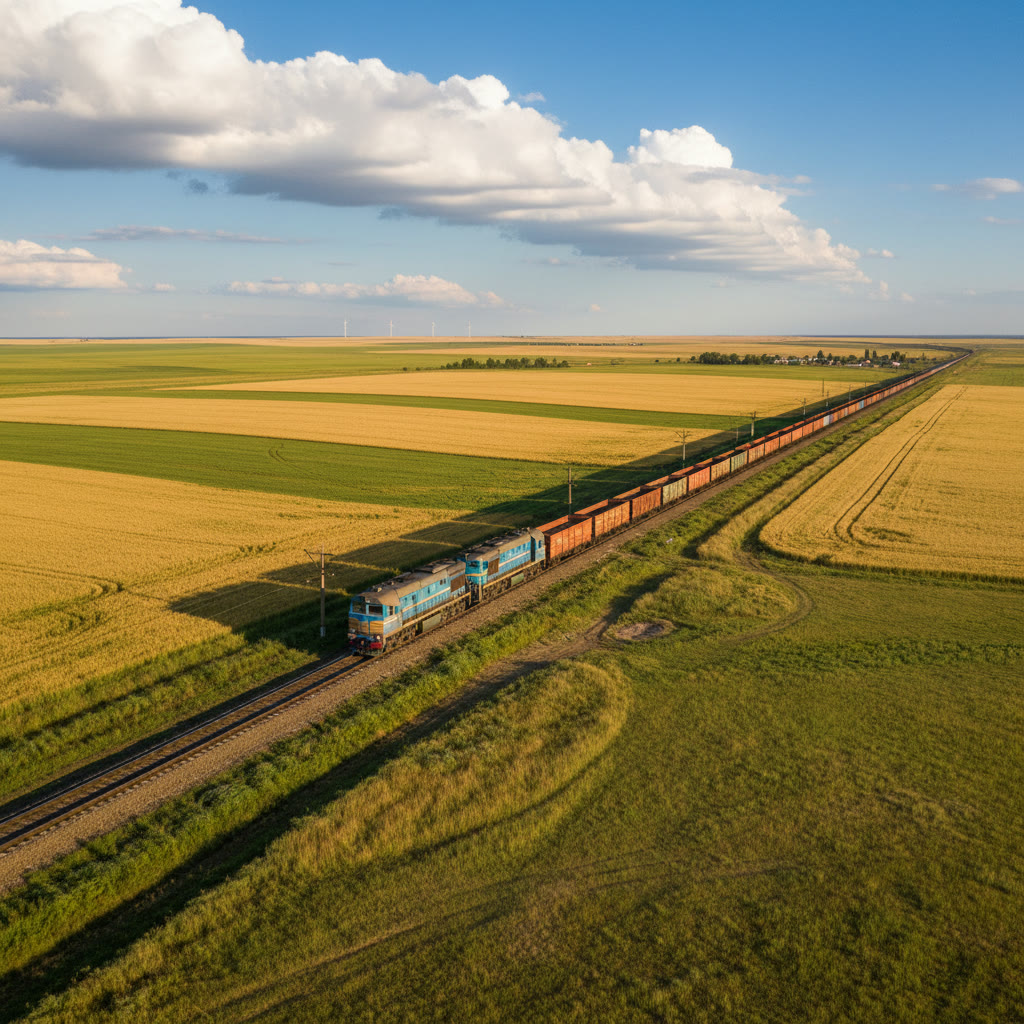
Direct rail from Kazakhstan through Alashankou (8,165 trains in 2025) and Khorgos (9,882 trains in 2025) to China, and onward to global markets. Transit time: 10-15 days from Central Asia to Chinese destinations.
Ocean Freight
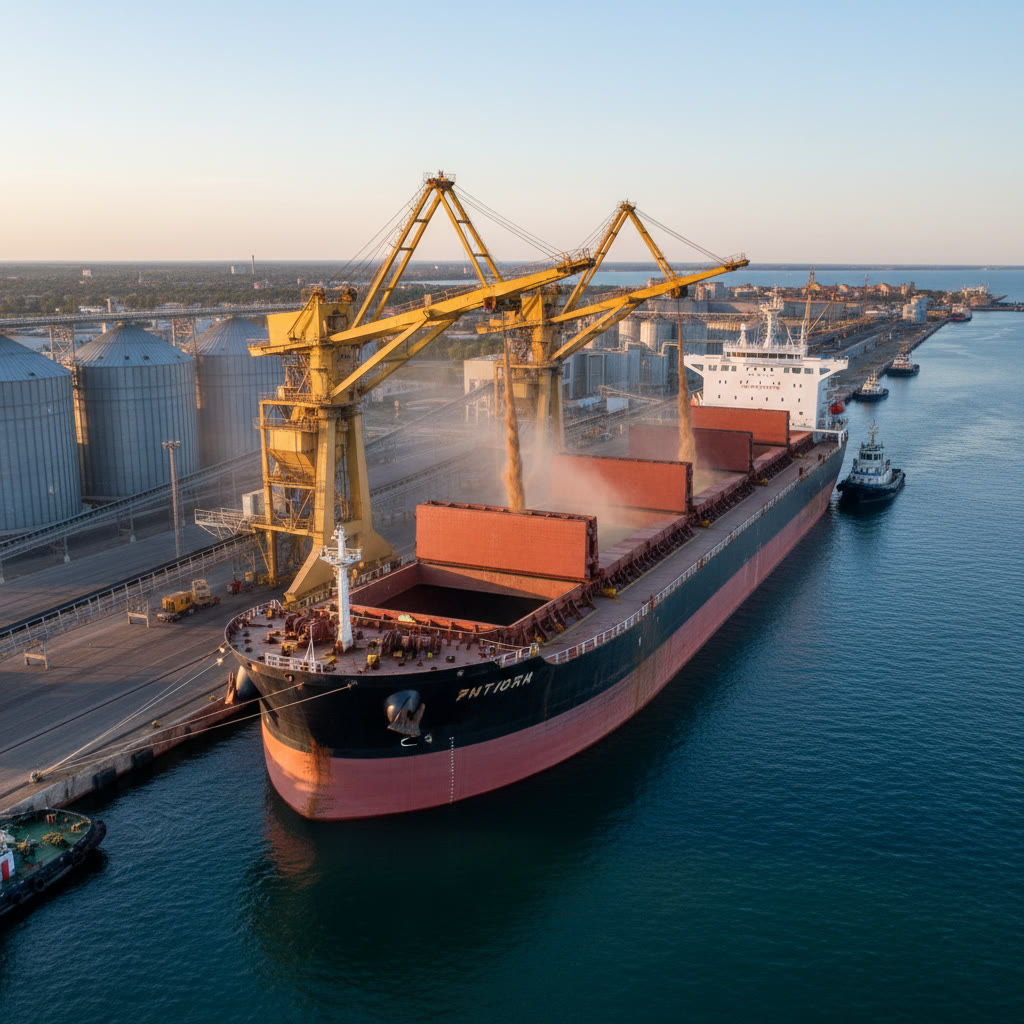
Major Loading Ports:
Tianjin, Qingdao, Hong Kong and Singapore (transshipment hubs). Bulk carriers and container vessels to Southeast Asia, Middle East, Africa, and beyond.
Road Transport
Khorgos Border Crossing:
20-30 ton trucks for flexible, fast-turnaround shipments. Ideal for smaller lots and time-sensitive deliveries. Direct trucking to China's western provinces and Central Asian neighbours.
Storage & Handling
Alashankou Free Trade Zone:
Bonded warehousing with 100,000+ MT capacity in the Alashankou FTZ. Grain elevators in Kazakhstan, transit storage at Chinese border ports, and distribution warehouses at key port cities.
Three Logistics Corridors from Central Asia to Global Markets
Central Asia's agricultural exports reach global markets through three primary corridors, each optimised for different cargo types, volumes, and destination regions. Our integrated approach allows us to select the most cost-effective and time-efficient combination for every shipment.
Corridor 1: Rail — The Backbone of Central Asia-China Trade
Rail transport forms the backbone of agricultural commodity movement from Kazakhstan into China. Two major border crossings handle the vast majority of overland trade between Central Asia and China, and both have seen dramatic capacity expansion in recent years.
Alashankou (Dostyk-Alashankou Crossing)
Alashankou, located in Xinjiang's Bortala Mongol Autonomous Prefecture, is the oldest and most established rail border crossing between Kazakhstan and China. In 2025, the crossing processed 8,165 freight trains — a testament to its role as the primary artery for Central Asian commodity flows into China. The Alashankou Free Trade Zone, where our sister company Basitao operates, provides bonded warehousing, customs clearance, and redistribution services. Goods arriving at Alashankou can be stored in the FTZ for up to two years with deferred customs duties, providing buyers with significant flexibility in managing inventory and cash flow.
The Alashankou FTZ offers grain-specific infrastructure including temperature-controlled storage, fumigation facilities, quarantine inspection laboratories, and bulk-to-container repackaging services. This is particularly valuable for agricultural commodities that require phytosanitary processing before entering the Chinese domestic market or being re-exported.
Khorgos (International Centre of Boundary Cooperation)
Khorgos has rapidly emerged as the busiest rail crossing on the China-Kazakhstan border, handling 9,882 trains in 2025. The Khorgos Gateway dry port, a joint venture between Kazakhstan and China, features a state-of-the-art gauge-changing facility that transfers cargo between the broad-gauge (1,520mm) rail used in Kazakhstan and the standard-gauge (1,435mm) system used in China. This process typically takes 6-12 hours per train, with modern cranes handling the container transfer efficiently.
The combined throughput of Alashankou and Khorgos — over 18,000 trains in 2025 — represents an enormous capacity for agricultural commodity flows. For bulk grain and oilseed shipments, the rail corridor from Kazakhstan's grain belt to Chinese border crossings typically takes 10-15 days, depending on origin point and routing. From the border crossings, onward rail transport to major Chinese cities takes an additional 3-7 days: approximately 3 days to Urumqi, 5 days to Xi'an or Chengdu, and 7 days to eastern seaboard cities like Tianjin or Lianyungang.
Rail transport is ideal for large-volume grain shipments (1,000 MT and above), offering consistent scheduling, competitive per-tonne costs, and lower damage rates compared to road transport. Standard rail wagons carry 60-70 tonnes of grain, and full block trains of 40-50 wagons can move 2,500-3,500 tonnes in a single shipment.
Corridor 2: Road — Flexibility for Smaller Volumes
The Khorgos road border crossing provides a complementary channel for agricultural commodity shipments, particularly suited to smaller lot sizes and time-sensitive deliveries. Standard trucks carry 20-30 tonnes per vehicle, making road transport economical for shipments ranging from a single truckload to small fleet convoys of 10-20 vehicles.
Road transport through Khorgos offers several distinct advantages. Transit times can be faster than rail for short-haul destinations in western China, with door-to-door delivery from Almaty to Urumqi achievable in 3-5 days. The flexibility of trucking means that shipments can be dispatched on short notice — often within 24-48 hours — without the scheduling constraints of rail. For buyers who need to test new product lines or fill urgent shortfalls, road transport provides the agility that rail cannot match.
The main Khorgos road crossing operates six days per week, with processing capacity of several hundred trucks per day. Customs clearance typically takes 4-8 hours for pre-documented shipments. Our logistics team coordinates all border paperwork, including customs declarations, phytosanitary certificates, weight certificates, and quality inspection reports, ensuring smooth passage through the border zone.
Road transport is particularly well-suited for high-value oilseeds (flaxseed, safflower seed) and specialty crops where lot integrity and traceability are paramount. Each truck carries a discrete, identifiable lot that can be traced from origin farm to destination warehouse without the commingling risk that can occur in bulk rail wagons.
Corridor 3: Sea — From Chinese Ports to Global Destinations
For international buyers beyond China, the sea corridor completes the supply chain by connecting Central Asian commodities — which arrive at Chinese ports via rail — to markets across Southeast Asia, the Middle East, South Asia, Africa, and beyond. This multimodal rail-to-sea approach is one of the most cost-effective ways to move bulk agricultural products from landlocked Central Asian origins to global destinations.
Key Loading Ports:
- Tianjin: China's largest dry bulk port in the north, with dedicated grain terminals capable of handling Panamax and Supramax vessels. Rail-connected to the Alashankou/Khorgos corridor via the Lanxin Railway. Tianjin is the preferred loading port for shipments to the Middle East, East Africa, and South Asia.
- Lianyungang: The eastern terminus of the New Eurasian Land Bridge, directly connected by rail to the Alashankou corridor. Lianyungang offers competitive port charges and efficient container handling for Southeast Asian destinations.
- Qingdao: A major container and bulk port serving East Asian and Pacific markets, with extensive feeder services to Japan, South Korea, and Taiwan.
- Hong Kong: As a global transshipment hub and the home of our corporate headquarters, Hong Kong provides access to virtually every major port worldwide. We maintain relationships with leading shipping lines for competitive freight rates.
Indicative Sea Transit Times from Chinese Ports:
| Destination Region | Transit Time | Typical Ports |
|---|---|---|
| Southeast Asia | 7 – 14 days | Ho Chi Minh City, Jakarta, Manila, Bangkok |
| Middle East | 15 – 20 days | Jebel Ali, Dammam, Bandar Abbas, Jeddah |
| South Asia | 12 – 18 days | Nhava Sheva, Mundra, Karachi, Colombo |
| East Africa | 18 – 25 days | Mombasa, Dar es Salaam, Djibouti |
| West Africa | 25 – 35 days | Lagos, Tema, Dakar |
| Mediterranean | 20 – 28 days | Istanbul, Mersin, Alexandria, Piraeus |
| East Asia | 3 – 7 days | Busan, Tokyo, Kaohsiung |
We offer both bulk vessel chartering (for shipments of 5,000 MT and above) and containerised shipping (for lots of 20-500 MT). Containerised shipping in 20-foot or 40-foot containers provides flexibility for buyers who need smaller quantities or multiple product types in a single shipment. Bulk chartering, using Handysize, Supramax, or Panamax vessels, delivers the lowest per-tonne freight cost for large-volume buyers.
Complete Transit Time Overview
| Route | Mode | Transit Time | Best For |
|---|---|---|---|
| Kazakhstan → China (border) | Rail | 10 – 15 days | Grains, seeds, all volumes |
| Kazakhstan → China (border) | Road | 3 – 5 days | Small lots, urgent delivery |
| China ports → Southeast Asia | Ocean | 7 – 14 days | All commodities |
| China ports → Middle East | Ocean | 15 – 20 days | Grains, oils |
| China ports → South Asia | Ocean | 12 – 18 days | Oilseeds, grains |
| China ports → East Africa | Ocean | 18 – 25 days | Bulk grains |
| Kazakhstan → Europe (rail) | Rail (China-Europe Express) | 12 – 18 days | High-value seeds, oils |
Warehousing in Alashankou Free Trade Zone
The Alashankou Free Trade Zone is a cornerstone of our logistics infrastructure. Operated in coordination with our sister company Basitao, the FTZ warehousing facilities provide:
- Bonded storage: Goods can be stored for up to 24 months with deferred customs duties, enabling buyers to manage inventory without upfront duty payments.
- Grain-specific facilities: Temperature and humidity monitoring, aeration systems, and pest control to maintain grain quality during storage.
- Repackaging services: Bulk-to-bag conversion (25kg, 50kg, or 1MT jumbo bags), container stuffing, and palletisation according to buyer specifications.
- Inspection and testing: On-site laboratories for moisture, protein, foreign matter, and mycotoxin testing. Full SGS or Bureau Veritas inspection can be arranged within 24-48 hours.
- Customs clearance: Dedicated customs brokerage team handling all import declarations, quarantine certificates, and phytosanitary documentation.
The strategic value of Alashankou FTZ warehousing cannot be overstated. It allows us to consolidate shipments from multiple Kazakh origins, blend products to meet exact buyer specifications, and dispatch to Chinese domestic buyers or re-export to third countries — all from a single, bonded facility.
Quality Control Checkpoints Along the Supply Chain
Maintaining product integrity from farm gate to final delivery is fundamental to our operations. We implement quality control checkpoints at every stage of the supply chain:
- Origin inspection (farm/elevator): Pre-purchase sampling and analysis to verify that the commodity meets contracted specifications. Moisture, protein, test weight, foreign matter, and mycotoxin levels are tested before purchase commitment.
- Loading inspection (rail/truck): Independent third-party inspection (SGS or Bureau Veritas) at the point of loading. Weight verification via certified scales, sealed wagon/truck documentation, and photographic evidence of loading conditions.
- Border crossing (Alashankou/Khorgos): Chinese customs inspection and quarantine (CIQ) sampling upon arrival. Phytosanitary verification and weight reconciliation against origin documents.
- Warehouse inspection (Alashankou FTZ): Receiving inspection upon arrival at bonded warehouse. Quality parameters are re-tested and compared against origin certificates. Any discrepancies are flagged immediately.
- Pre-shipment inspection (port): Final inspection before ocean loading. For containerised shipments, container condition checks, fumigation certification, and seal integrity verification. For bulk shipments, draft survey and hold inspection.
- Destination inspection (optional): We can arrange discharge inspection at the destination port, including weight verification (draft survey), quality sampling, and condition reporting.
All inspection reports, certificates of origin, phytosanitary certificates, weight certificates, and quality analysis reports are compiled into a comprehensive document package and provided to the buyer. Digital copies are shared in real-time via our document management system, ensuring full transparency throughout the shipment lifecycle.
Delivery Terms (Incoterms 2020)
We offer a comprehensive range of Incoterms 2020 delivery terms to match the needs and risk appetite of every buyer, from ex-works collection to fully delivered solutions.
| Term | Description | Buyer's Responsibility From |
|---|---|---|
| EXW | Ex Works — goods made available at the seller's premises (farm, elevator, or warehouse) | Seller's premises (collection point) |
| FOB | Free On Board — goods loaded onto vessel at origin port | Origin port (after loading) |
| CFR | Cost & Freight — delivered to destination port, buyer arranges insurance | Destination port |
| CIF | Cost, Insurance & Freight — delivered to destination port, insured by seller | Destination port |
EXW (Ex Works) is available for buyers who have their own logistics arrangements in Kazakhstan or at the Alashankou FTZ. This term offers the lowest commodity price as it excludes all transport costs. It is popular with Chinese domestic buyers who collect directly from our Alashankou bonded warehouse.
FOB (Free On Board) is our most commonly requested term for international shipments. The buyer takes ownership once goods are loaded onto the vessel at the named port (typically Tianjin or Lianyungang). This is ideal for buyers with established freight contracts or who prefer to manage their own shipping.
CFR (Cost and Freight) includes freight to the buyer's nominated destination port. The buyer arranges and pays for marine cargo insurance separately. This is a good option for experienced importers who have competitive insurance arrangements.
CIF (Cost, Insurance and Freight) provides the most comprehensive coverage, with marine cargo insurance arranged and paid for by EUSCG. This is the preferred term for first-time buyers or those who want a single, all-inclusive price to their destination port.
For special routing requirements — such as cross-border delivery to landlocked countries, multi-modal shipments, or delivered duty paid (DDP) arrangements — please contact our logistics team to discuss customised solutions.